
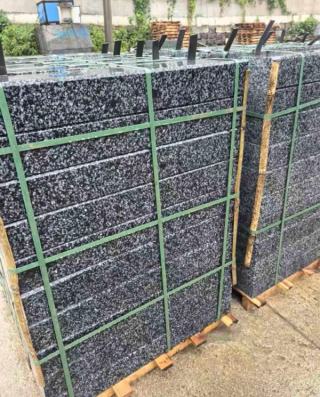
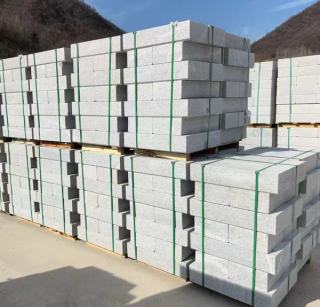
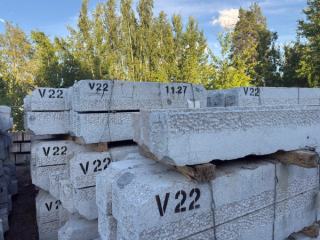
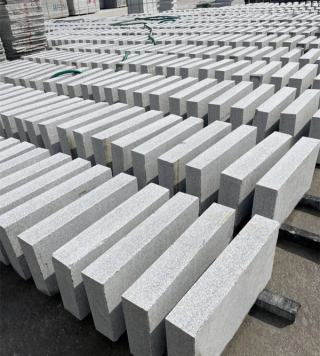
Granite kerbstones are widely used along urban roads, private driveways, hotel entrances, commercial plazas and landscape paving boundaries. When first installed, they usually form clean lines and consistent levels. Over time, however, some projects may begin to show problems such as tilting, loosening, settlement or lateral movement.
When these problems appear, it is easy to assume that the kerbstones are too small or not heavy enough.
In reality, natural granite has high density, strength and durability. Whether a kerbstone remains stable over the long term depends not only on the stone itself, but also on the load-bearing capacity of the sub-base, foundation support, lateral haunching, installation depth, adjacent paving, vehicle loads and drainage conditions.
For this reason, kerbstone stability should be considered as part of a complete installation system rather than relying simply on larger or heavier stone.
1. Granite Is Heavy, So Why Can Kerbstones Still Move?
Once installed, a granite kerbstone is exposed to more than its own weight.
Adjacent paving may create lateral forces, vehicles travelling, turning or braking near the edge can change local loading conditions, the sub-base may settle over time, and rainwater may enter the foundation structure. In colder climates, repeated freeze-thaw cycles can also affect the stability of the supporting layers.
These conditions become particularly important around private driveways, parking areas, hotel vehicle entrances and road bends, where kerbstones are exposed to more demanding conditions than those used simply as garden boundaries.
The key question is therefore not whether the granite is “heavy enough”, but:
Does the kerbstone have stable support underneath and sufficient restraint at the sides?
If either condition is inadequate, even relatively large granite kerbstones may gradually move over time.
2. An Unstable Sub-Base Is a Major Cause of Settlement and Tilting
Small problems in the sub-base may not be immediately visible after installation.
If the sub-base is insufficiently compacted or its load-bearing capacity varies from one location to another, uneven settlement can gradually develop under rainfall and long-term loading.
When an entire kerbstone settles, it may create a level difference with the adjacent units. If settlement occurs mainly beneath one side, the kerbstone may begin to tilt.
This deserves particular attention in newly backfilled areas, around underground utilities, along road edges and in locations that have previously been excavated and refilled.
Controlling the finished level during installation is therefore only the first step.
What determines whether that level can still be maintained years later is a stable, uniformly compacted and adequately load-bearing sub-base.
3. What Are the Different Roles of the Foundation and Haunching?
Providing a stable foundation beneath granite kerbstones is important, but bottom support alone does not necessarily create a stable system.
The foundation primarily supports the kerbstone and transfers its own weight and external loads into the structure below.
However, kerbstones must also resist lateral forces.
For this reason, many installation systems use concrete haunching along the side of the kerbstone to provide additional restraint, allowing the foundation, kerbstone and haunching to work together.
In simple terms:
The foundation provides support from below, while the haunching helps resist tilting and lateral movement.
If adequate bottom support is provided but lateral restraint is insufficient, long-term pressure from adjacent paving, soil or vehicle activity may still cause the kerbstone to rotate gradually.
This explains why some kerbstones show little obvious settlement but eventually lean to one side.
4. More Haunching Is Not Always Better
If haunching improves stability, does using more concrete automatically create a better installation?
Not necessarily.
The foundation and haunching should be designed according to the kerbstone dimensions, exposed height, adjacent paving, application area and expected loads.
For example, a granite kerbstone used along a private garden path and one installed at a hotel vehicle entrance or commercial parking area may experience completely different loading conditions, even when the kerbstones themselves have identical dimensions.
A more appropriate design sequence is therefore:
Determine the application and expected loads first, then select the kerbstone dimensions and design the corresponding foundation and lateral support.
The specific foundation dimensions, haunching height, material strength and construction method should follow the project design and relevant local engineering requirements rather than applying one fixed specification to every project.
5. Why Does the Exposed Height Affect Stability?
There is a direct relationship between the total height of a kerbstone, its installation depth and the amount left exposed above the finished surface.
If a tall kerbstone is largely exposed above ground while only a relatively small section is restrained within the foundation, lateral forces acting on the upper section can create a greater tendency for the stone to rotate.
This does not mean that every kerbstone should simply be installed as deeply as possible.
In real projects, exposed height must usually coordinate with road levels, paving thickness, drainage and landscape design. The total kerbstone height, exposed height, foundation depth and lateral haunching therefore need to be considered together.
Exposed height is not only a visual design consideration; it is also part of the installation structure.
6. Why Does Adjacent Paving Affect Kerbstone Stability?
Kerbstones rarely function as isolated elements.
One side may contain granite cobblestones, paving slabs, asphalt or concrete, while the other side may contain planting, soil or another landscape structure.
For granite cobblestone paving, for example, kerbstones often provide essential edge restraint. If the boundary structure is unstable, paving units may gradually spread outward under long-term pedestrian or vehicle loading, potentially leading to loose edges and changing joint widths.
Conversely, an improperly constructed paving base may continuously transfer forces toward the kerbstones.
For this reason, roads and landscape projects should not treat kerbstones and paving as completely separate systems.
Kerbstones, paving, the sub-base and drainage together form a continuous edge system.
7. Why Do Driveways and Hotel Entrances Require Greater Stability?
Vehicle loads involve more than simply the weight of a vehicle.
When vehicles turn, brake, park or accelerate near the road edge, they can create more complex forces than those found in ordinary pedestrian areas.
This is particularly important on curved driveways, hotel entrances and parking areas, where vehicle paths may pass very close to the kerbstones.
Therefore, the same granite kerbstone used along a garden boundary and in an area with frequent vehicle traffic should not automatically use the same foundation design.
For vehicle-access areas, vehicle type, traffic frequency, turning locations and the loads likely to reach the pavement edge should be considered before determining the foundation and lateral restraint.
8. Why Are Curved Areas More Sensitive to Installation Errors?
Straight kerbstone runs mainly require control of level, alignment and joints. Curved sections also require careful control of radius and the orientation of each individual stone.
If the first few kerbstones are installed with small angular errors and subsequent units follow those positions, the error may gradually accumulate.
To return to the intended curve, installers may eventually need to make sudden adjustments to joint widths or stone orientation. This can affect not only the visual continuity of the curve but also the consistency of the foundation and haunching.
Accurate setting-out is therefore particularly important for curved driveways, circular entrances and landscape borders.
For projects with demanding design requirements, it is also worth determining during procurement whether curved, corner or custom-shaped granite kerbstones are required rather than relying entirely on standard straight units adjusted on site.
9. Why Can Drainage Affect Kerbstone Stability?
The effect of water on kerbstone stability is often gradual rather than immediate.
If rainwater repeatedly enters the sub-base around the kerbstones or drainage is poor in certain locations, the condition of the supporting materials may change over time.
In climates with freeze-thaw cycles, prolonged moisture within the supporting layers can make these conditions even more demanding.
This is why a project may look completely stable when first completed but begin to show local settlement, uneven joints or tilting after several wet seasons or winters.
When designing a kerbstone foundation, it is therefore important not only to consider how the stone will be restrained, but also:
Where will the water go?
Foundation stability and drainage should be considered together as part of the overall paving system.
10. Why Do Only a Few Kerbstones Sometimes Develop Problems?
If most kerbstones along a road remain stable while only a few units tilt, loosen or settle, local construction conditions are often worth investigating first.
An area close to underground services may have been excavated and backfilled. Compaction may vary at one location, the foundation thickness may change, the haunching may be interrupted, water may collect at a low point, or two different sub-base structures may meet in the same area.
These differences may not be visible immediately after completion.
They often become apparent only after prolonged use.
For this reason, inspections should consider not only the overall alignment but also corners, ends, changes in gradient, drainage points, vehicle entrances and transitions between different foundation structures.
These areas are often where weaknesses in the installation system become visible first.
11. Can Larger and Heavier Kerbstones Solve the Problem?
Larger dimensions and greater self-weight can improve stability under certain conditions, but they cannot replace a correctly designed foundation.
If the sub-base settles, a heavier kerbstone can still settle with it. If lateral restraint is insufficient, increasing the stone weight alone may not prevent long-term tilting.
Kerbstone dimensions should therefore not simply follow the principle that “bigger is always more stable”.
A more reliable approach is to select the appropriate kerbstone size according to road function, landscape proportions, exposed height, adjacent paving and vehicle conditions, and then design the sub-base, foundation and haunching accordingly.
The stone dimensions and installation structure should work together rather than being considered separately.
12. What Should Be Controlled During Installation?
The most effective way to reduce future tilting, loosening and movement is to establish consistent quality control during installation.
Before construction begins, the actual application and expected loading conditions should be understood, while the sub-base should provide stable and uniform support. Backfilled and previously excavated areas require particular attention to compaction and foundation preparation.
During installation, the foundation and lateral haunching should be appropriate for the selected kerbstone dimensions. Level, vertical alignment, overall line and joints should be checked continuously rather than corrected only after an entire section has been installed.
When adjacent paving is constructed, care should also be taken not to disturb the installed kerbstones, while drainage should be integrated into the overall paving structure.
None of these measures is particularly complicated on its own, but long-term stability often depends on all of them working together.
13. Why Should the Final Application Be Considered When Purchasing Granite Kerbstones?
For project procurement, the specifications of the stone itself are naturally important.
The granite type and colour influence the overall material appearance, while length, width and height must correspond with the design and installation structure. Surface finish, edge treatment, dimensional accuracy and tolerances also need to meet project requirements.
However, these specifications mainly answer one question:
“What type of kerbstone needs to be produced?”
For an engineering project, another question is equally important:
“Is this specification suitable for the actual application?”
The same granite kerbstone may be used in a private courtyard, residential driveway, hotel entrance, commercial plaza or urban road, but the installation conditions and loads can be very different.
Considering the application area, exposed height, adjacent paving and vehicle use before finalising the product specification can reduce the risk of discovering incompatibilities between the supplied stone and the site installation structure after production.
This is particularly important for curved units, corner pieces and custom-sized granite kerbstones.
14. Long-Term Stability Comes from a Complete Kerbstone Installation System
Natural granite offers high strength, wear resistance and excellent outdoor durability, making it well suited to roads, driveways, plazas and landscape boundaries.
But high-quality granite cannot replace correct engineering and installation.
Tilting, loosening, settlement or movement of kerbstones is often the result of several interacting factors, including insufficient sub-base support, an unstable foundation, inadequate lateral haunching, unsuitable installation depth, forces from adjacent paving, vehicle loading and drainage conditions.
For landscape designers, contractors and project buyers, the most reliable approach is therefore not to search for a granite kerbstone that will “never move”, but to establish a complete system combining:
appropriate stone dimensions, a stable sub-base, a suitable foundation, effective lateral haunching, correct installation control and proper drainage.
The quality of a granite kerbstone boundary should not be judged only by how straight and clean it looks immediately after installation.
The more meaningful test is whether it can maintain consistent levels, continuous alignment and a clear landscape edge after years of vehicle use, rainfall, temperature changes and outdoor exposure.
That is the long-term performance a properly designed granite kerbstone installation should achieve.