
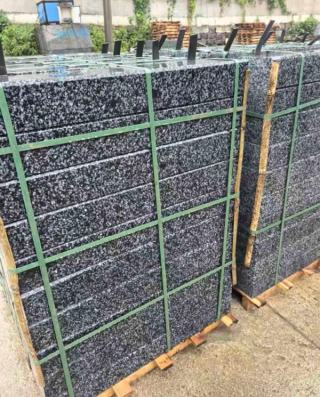
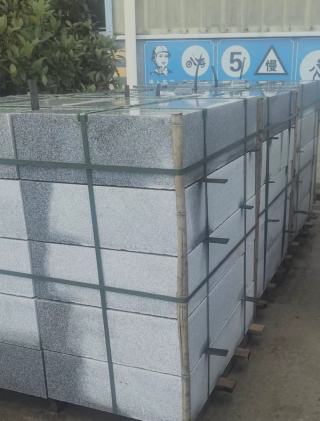
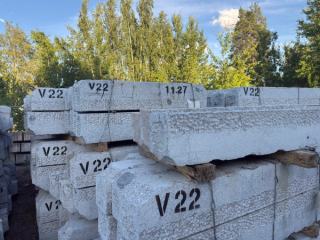
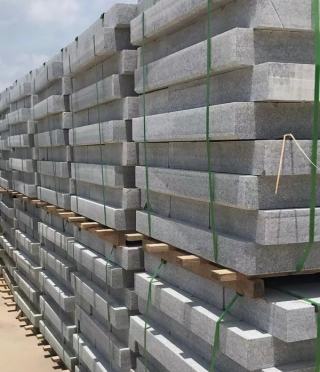
Granite kerbstones, also referred to as granite curbstones in some markets, are widely used in roads, hotel entrances, commercial developments, residential landscapes and public-space projects. Once the quotation has been accepted, buyers often assume that confirming the stone type, dimensions and quantity is enough to release the order for production.
For standard stock products, that may sometimes be sufficient. For project-based granite kerbstones, however, a formal purchase order needs to define much more than length, width and height.
Two kerbstones can both be listed as 1000 × 150 × 300 mm and still require different production methods depending on which faces are visible, which surfaces need finishing, how the end faces should be treated, whether the top edges require chamfers, and whether the order includes radius kerbs, corners, transition pieces or other custom components.
Before bulk production begins, the real purchasing question is therefore not simply:
What size kerbstone are we buying?
It is:
Has the design intent been converted into production information that the factory can execute without interpretation?
1. Cross-Section Dimensions Need a Clear Orientation
A typical granite kerbstone specification may be written as 1000 × 150 × 300 mm. In most cases this means length × width × height, but dimensions alone do not always explain how the unit is installed.
Kerbstones have a clear orientation in the finished project. The top forms a continuous visible line, one long face may be exposed toward the road or paving, and the opposite face may be buried or installed against landscaping, concrete support or another construction layer.
If the design includes a sloping face, chamfer, bevel, rounded edge or other asymmetric detail, the factory must know exactly where that feature belongs.
For this reason, the final purchase documentation should identify not only length, width and height but also the orientation of the cross-section. A simple section drawing showing the top face, road-facing side and rear side can eliminate many misunderstandings.
This does not require a complicated set of drawings. The objective is simply to create one common orientation that can then be used for surface finishes, edge details, end treatment and special pieces.
2. The Purchase Order Should Identify Every Exposed Face
One of the main differences between kerbstones and ordinary paving slabs is that a kerbstone may have more than one visible face after installation.
On a typical roadside installation, the top and the front face may remain visible. At a hotel drop-off, commercial entrance or high-end landscape edge, the side face may be much more prominent. At certain termination points, even an end face may remain exposed.
A purchase order that states only “sawn finish,” “flamed finish” or another surface finish without identifying where that finish is required can therefore leave too much room for interpretation.
A more precise specification should confirm the required finish for the top face, exposed side face, rear face and any other visible area.
If only the top and one long side require finished surfaces while the back is concealed, this should also be stated. It prevents unnecessary processing and reduces the risk of the factory applying the correct finish to the wrong face.
For granite kerbstone procurement, defining which faces are visible is often just as important as defining the finish itself.
3. End Faces Are Often Overlooked in Kerbstone Orders
The end faces of standard straight kerbstones are easy to ignore because most pieces are installed end to end and form continuous joints.
However, not every end face will be hidden by an adjacent kerbstone.
Road terminations, entrance breaks, steps, planting edges, isolated landscape boundaries and other project details can leave one or more ends permanently exposed.
If these positions are not identified in advance, the factory may process them as normal joint faces. Once the material arrives on site, the contractor may then need to recut or refinish the visible end.
A better approach is to distinguish between standard joint ends and exposed finished ends before production.
If the project requires dedicated left-end pieces, right-end pieces or terminal kerbs, they should be listed separately rather than included within the quantity of standard straight units.
This is a small purchasing detail, but it can prevent unnecessary site cutting and inconsistent finishes at highly visible locations.
4. Chamfers, Rounded Edges and Edge Treatments Must Be Measurable
Many landscape and road projects use a chamfer, rounded edge or another edge treatment along the top of granite kerbstones. These details may be intended to reduce sharp edges, improve durability or create a cleaner visual line.
Descriptions such as “small chamfer,” “slightly rounded” or “soft edge” may communicate the design idea, but they are not reliable production instructions.
When the project has a defined edge treatment, the purchase order or technical attachment should identify where the treatment is applied and, where appropriate, its actual dimensions.
For example, buyers should clarify whether the chamfer is required on the road-facing top edge only, on both top edges, or on specific kerbstone types. They should also confirm whether the same treatment applies to radius kerbs, corners and terminal pieces.
If a dimensional chamfer or radius is required, it is better to show it directly on the cross-section.
The objective is not to over-specify every project. It is to avoid a situation where the buyer and factory both understand the phrase “small chamfer” differently.
5. Standard Straight Kerbs and Special Pieces Should Be Ordered Separately
Most granite kerbstone projects contain a large proportion of standard straight units. The items that create the greatest procurement risk, however, are often the smaller number of special pieces.
These may include radius kerbs, corner units, short pieces, ramp transitions, end pieces, sloped units and other custom components produced from project drawings.
If the purchase order only lists a total number of linear metres, the factory cannot determine how much of the order should be produced as standard straight kerbstones and how much belongs to custom shapes.
A better purchasing structure separates standard and special components.
Standard straight kerbstones can be managed by common dimensions and piece quantities. Special pieces should be linked to individual item codes, quantities and drawings.
This distinction makes production clearer and helps ensure that low-volume but critical project components are not hidden inside the overall kerbstone quantity.
6. Radius Kerbstones Need More Than One Radius Number
Detailed radius design belongs in the technical drawings, but from a procurement perspective there is one point that must be confirmed before the order is released: a curved kerbstone should not be identified only by a radius value.
A kerbstone with a defined width has an inner radius, a centreline radius and an outer radius. If the design team uses one reference and the factory assumes another, both parties may appear to be working with the same numerical radius while producing different geometry.
The order documentation should therefore identify which reference line the radius applies to.
Each radius kerb should also be linked to its location, item code and quantity. If several radii are used within the same project, they should be listed as separate product types.
The purchasing team does not need to redesign the curve, but it does need to ensure that every curved component has a clear and traceable production reference.
7. Left-Hand and Right-Hand Special Pieces Need Clear Identification
Some custom kerbstones are directional rather than symmetrical.
Ramp transitions, sloped pieces, special terminals and certain corner details may need separate left-hand and right-hand versions.
Simply describing an item as “left” or “right” can still create misunderstandings because different teams may view the component from different directions. A designer may define left and right according to the direction of travel, while factory staff may view the stone from its exposed face.
A more reliable method is to assign a unique code to each directional component and show its orientation in a simple drawing.
Instead of relying only on “LH” and “RH,” each piece can be identified by a project-specific product code that corresponds directly to the shop drawing or installation plan.
For small quantities of critical special pieces, this type of coding is particularly valuable because a directional error can make the product unusable even when all dimensions are otherwise correct.
8. Tolerances and Straightness Should Be Part of the Acceptance Basis
Granite is a natural material, but kerbstones are still manufactured project components. Length, width, height, straightness and surface finish need a clear basis for production and inspection.
If a purchase order states only nominal dimensions without identifying any agreed tolerance or quality requirement, the buyer and supplier may later use different standards to decide whether the finished products are acceptable.
For higher-specification projects, dimensional tolerances and relevant processing requirements should therefore be included in the order or technical specification.
The purpose is not to apply one universal tolerance to every granite kerbstone project. Different applications, finishes and local specifications may require different standards.
The important point is that the buyer and supplier should agree before production on which standard will be used to manufacture and inspect the order.
Detailed discussion of straightness and dimensional consistency can be handled in a separate quality-control specification. In the purchase order, the priority is to establish the agreed acceptance basis.
9. Linear Metres Are a Project Quantity; Production Requires Piece Counts
Road and landscape drawings commonly measure kerbstones in linear metres. This is useful for quantity take-offs and budgeting, but the factory ultimately produces individual stone units.
For a standard 1000 mm straight kerbstone, converting linear metres into pieces is relatively straightforward. Once the project includes 500 mm units, short closure pieces, radius kerbs, corners and terminals, however, the total linear metre quantity is no longer enough for production.
At the formal-order stage, each product type should therefore be converted into an actual piece quantity.
Standard straight units may still retain linear metres as a project reference, but the confirmed order should also show the number of pieces. Custom items should normally be listed by item code and piece quantity.
This makes it easier to verify production quantities, packaging, delivery and final site receipt.
10. The Final Purchase Order Must Refer to One Valid Drawing Version
Complex kerbstone projects often include a product schedule, plan drawings, sections, detail drawings and shop drawings for special pieces. If these documents have been revised at different times, the production order must clearly identify which version is valid.
Otherwise, the purchasing schedule may use the latest dimensions while the factory is still working from an earlier detail drawing. A special-piece quantity may have changed while an obsolete drawing remains in circulation.
Before production is released, the purchase order, kerbstone schedule and custom-piece drawings should therefore refer to the same approved version.
If later design changes occur, they should be issued through a clear revision or variation record rather than allowing several different versions to circulate at the same time.
Version control is especially important for radius kerbs, terminal pieces, transitions and other custom units because once they are produced to the wrong geometry, correction options can be limited.
11. What Should a Production-Ready Granite Kerbstone Order Include?
Before a formal granite kerbstone order is released, the supplier should be able to identify the stone type or colour, length, width and height, cross-section orientation, exposed faces, surface finish for each relevant face, end-face requirements, chamfers or rounded edges, standard straight-piece quantities, special-piece codes and quantities, drawings for radius and custom units, directional component identification, the applicable drawing revision and the agreed acceptance requirements.
Not every simple kerbstone order requires a large technical package.
However, once a project includes curves, corners, ramps, exposed terminals or other custom details, these components should be separated from the standard kerbstone quantity and given clear production references.
The clearer the purchasing information, the less the factory has to interpret from experience.
Conclusion: A Purchase Order Should Convert Design Intent into Production Instructions
Once granite kerbstone procurement moves from quotation to formal order, the purpose of the purchasing documents changes.
At the RFQ stage, the supplier needs enough information to understand the project and prepare a realistic quotation. At the final-order stage, those requirements need to be converted into instructions that can be manufactured and inspected without ambiguity.
A production-ready granite kerbstone order should therefore follow a clear sequence:
confirm the granite and cross-section → define installation orientation and exposed faces → specify surface finishes → confirm end faces and edge treatments → separate standard and custom pieces → code radius, corner and directional units → convert linear metres into piece quantities → confirm the current drawing revision and acceptance criteria.
When these points are resolved before bulk production, the supplier no longer receives an order that simply says how many metres of granite kerbstone are required. Instead, it receives a complete and traceable production specification.
For granite importers, stone distributors, landscape contractors and project procurement teams, this reduces more than communication time. It also lowers the risk of discovering after production that exposed faces were finished incorrectly, special pieces were omitted, directional components were reversed or site installation requires avoidable reworking.