
Once granite cobblestone paving has been installed, the long-term performance and overall appearance depend on more than the stone itself. Joint width, jointing material and laying pattern are also important parts of the complete paving system.
In real projects, two seemingly opposite approaches are common. Some projects aim for very narrow joints to create a clean and precise appearance, while others deliberately use wider joints to achieve a more traditional natural-stone character.
So, how wide should the joints between granite cobblestones actually be?
There is no single fixed dimension suitable for every project. The appropriate joint width should be determined by considering stone dimensional tolerances, surface and edge finish, laying pattern, base construction, jointing system and expected loads.
1. Why Should Granite Cobblestone Joints Not Simply Be Made as Narrow as Possible?
Granite cobblestones are natural stone products. Unlike highly standardised ceramic tiles or manufactured concrete pavers, individual pieces may show reasonable variations in actual dimensions, edge shape and surface level, even when supplied to the same nominal size.
This is particularly noticeable with naturally split cobblestones, where the edges formed by splitting are not perfectly straight.
If joints are made excessively narrow purely for visual reasons, slightly larger stones may become difficult to position correctly. Installers may then need to spend considerable time adjusting, sorting or even reworking individual pieces.
The joint therefore serves an important practical purpose:
It accommodates reasonable dimensional variation in natural stone and provides space for adjustment during installation.
Good cobblestone paving is not simply about achieving the narrowest possible joints. It is about finding the right balance between the natural characteristics of the stone and the overall order of the finished pavement.
2. Why Does the Stone Finish Affect Joint Width?
Different manufacturing and finishing methods produce different edge profiles and levels of dimensional consistency. For this reason, the same jointing approach should not automatically be applied to every type of granite cobblestone.
Naturally Split Granite Cobblestones
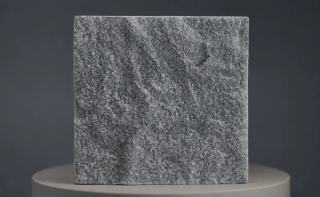
Naturally split cobblestones generally have more noticeable variations along their edges.
This type of stone can create a traditional, natural and richly textured paving surface, but sufficient adjustment space is needed during installation.
If joints are too narrow, irregular natural edges may interfere with one another and make it more difficult to maintain consistent paving lines.
For this type of paving, the priority should therefore be:
achieving visually balanced joints across the entire surface rather than making every individual joint exactly the same width.
Tumbled Granite Cobblestones
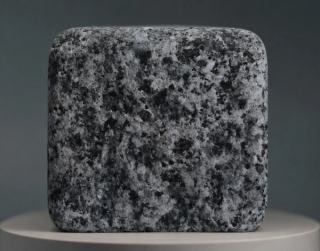
After tumbling, the edges and corners of granite cobblestones are generally softer and more rounded, creating a smoother visual transition between individual stones.
Where cutting and dimensional control are consistent before tumbling, the paving can usually be laid with a more regular overall arrangement.
However, rounded edges can make the joint appear wider when viewed from the top. When evaluating joint width for tumbled cobblestones, it is therefore important not to judge only the visible gap between the rounded upper edges, but also to consider the actual spacing between the main bodies of the stones.
3. Do Larger Cobblestones Always Require Wider Joints?
Not necessarily.
Stone size is only one factor affecting joint width. Dimensional tolerance and edge profile are often more important.
For example, consider two types of approximately 100 mm square granite cobblestones.
A product with well-controlled dimensions and relatively regular edges may allow a more consistent joint pattern.
A naturally split product with greater edge variation may require additional space for adjustment during laying.
Designers and installers should therefore not determine joint width solely from the nominal dimensions shown in a product catalogue.
It is more useful to understand:
the actual dimensional range, manufacturing method and permitted tolerances.
For larger projects, a small trial installation can also be prepared before full-scale construction. This allows the final joint appearance to be evaluated using the actual stone supplied for the project.
4. Why Do Different Laying Patterns Require Different Joint Control?
Granite cobblestones are not limited to simple straight-line layouts.
In European courtyards, historic environments, hotel entrances, commercial plazas and high-end residential driveways, cobblestones are often laid in running bond, curved, fan-shaped and other decorative patterns.
Straight and Staggered Patterns
These patterns emphasise visual order, so continuity of longitudinal and transverse joint lines becomes particularly important.
The objective is not necessarily to make every joint exactly the same width, but to avoid obvious and distracting variations between excessively narrow and wide joints.
Curved Patterns
When square or approximately square cobblestones are arranged along a curve, the joints themselves help accommodate changes in direction.
If every joint is forced to maintain exactly the same width, the resulting curve may actually appear less natural.
Fan-Shaped Patterns
Traditional European natural-stone paving frequently uses fan-shaped layouts.
The key to this type of installation is controlling the geometry of the entire fan rather than focusing on the width of a single joint around an individual stone.
For more complex laying patterns:
overall geometric order is often more important than absolute uniformity of every individual joint.
5. Why Does Jointing Material Affect Cobblestone Stability?
A paving joint is more than a visual separation between stones.
Within a granite cobblestone paving system, the jointing material also contributes to load transfer and lateral restraint between individual units.
If jointing material is lost, lateral support between neighbouring stones can gradually decrease. Under repeated vehicle traffic, pedestrian loads, rainwater erosion or freeze-thaw cycles, individual cobblestones may begin to move slightly.
Over time, this can lead to:
widening joints, rocking stones, displacement and eventually local deformation of the paved surface.
The jointing system should therefore be selected with the intended use, base construction, drainage conditions and maintenance requirements of the project in mind.
A pedestrian courtyard and a driveway exposed to frequent vehicle traffic do not necessarily require the same jointing approach.
6. Should Driveways, Courtyards and Public Spaces Use the Same Joint Width?
Not necessarily, especially if the decision is based only on appearance.
Different applications experience different loads and operating conditions.
Private courtyards and pedestrian areas often place greater emphasis on texture, colour and overall visual composition.
Residential driveways and hotel entrances must also account for the horizontal forces created by vehicle turning, braking and repeated traffic.
Commercial plazas and public spaces may additionally require consideration of intensive long-term use, drainage, cleaning and maintenance.
As a result, even when the same granite cobblestone is used, the paving structure and jointing approach may need to change according to the application.
This is also why construction details should not be determined solely from a visual rendering or design image.
7. Why Is a Trial Installation Recommended Before Full-Scale Laying?
For natural granite cobblestones, especially products with noticeable natural texture, colour variation or irregular edges, a small trial installation can be extremely useful.
A trial area allows the project team to evaluate:
actual dimensional variation, the visual appearance of the joints, colour distribution, laying direction and the overall effect of mixing stones from different batches.
Designers, suppliers and installers can also use the trial area to agree on the expected standard of the finished paving before full-scale installation begins.
Compared with making adjustments after a large area has already been completed, confirming these details in advance can significantly reduce the risk of rework.
This is particularly valuable for large high-end landscape projects.
8. So, How Wide Should Granite Cobblestone Joints Actually Be?
It is a simple question, but the correct answer depends on the specific conditions of the project.
An appropriate joint width for granite cobblestones should not be determined independently of:
stone size and dimensional tolerances, edge finish, laying pattern, base construction, jointing system, drainage conditions and expected loads.
Instead of searching for one fixed joint width that applies to every cobblestone project, it is more practical to establish a suitable range based on the actual stone and the complete paving system.
For naturally split products, the natural variation of the stone edges should be respected.
For tumbled or more precisely processed products with good dimensional control, a more regular overall layout may be achievable.
For driveways and public spaces, long-term structural stability should take priority over achieving a particular visual joint width.
Conclusion
The joints in granite cobblestone paving may appear to be only a small part of the finished surface, but they directly influence visual order, installation tolerance, drainage performance and long-term stability.
A well-designed cobblestone pavement is not created by simply assuming that “narrower joints look more premium,” nor by applying the same fixed joint width to every project.
Instead, it requires an understanding of the characteristics of natural stone and coordination between stone dimensions, dimensional tolerances, laying patterns, base construction, jointing and the actual conditions of use.
For large landscape projects, residential driveways, hotel entrances and public spaces, preparing a trial installation with the actual stone and allowing the designer, supplier and installer to agree on the final paving appearance can often provide a more reliable result than specifying a single fixed joint width in isolation.