
In many contemporary residences, boutique hotels, and high-end landscape projects, designers want to preserve the clean order of modern architecture while introducing the warmth and depth that natural materials develop over time.
Aged granite cobblestones can provide exactly this balance.
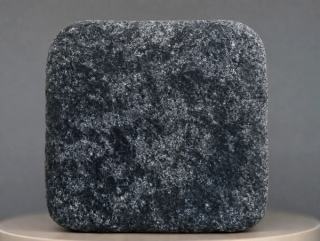
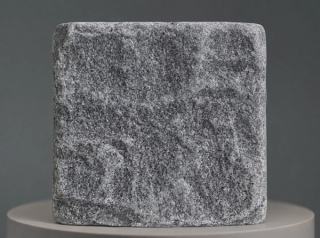
Through controlled edge wear, surface treatment, and overall colour blending, the stone loses some of the sharpness and mechanical uniformity associated with newly processed materials. The result is a softer, more natural paving character that feels settled into the landscape.
However, there is also a common design risk.
If the ageing effect is too strong, or if aged cobblestones are combined with too many traditional architectural details, complex paving patterns, and decorative historical elements, the intended sense of time can quickly become an overly deliberate “heritage” look.
For this reason, the real question when using aged granite cobblestones with modern architecture is not:
How can the paving be made to look older?
It is:
How can the natural character of aged stone soften modern architecture without weakening its contemporary identity?
These are two very different design approaches.
Why Modern Architecture Benefits from a Sense of Time
Modern architecture is often defined by clear geometric relationships.
Large areas of glass, metal details, concrete walls, restrained façades, and straight architectural lines create a rational, controlled, and highly ordered visual language.
There is nothing inherently wrong with this approach.
However, when the surrounding paving also uses materials with extremely uniform colours, perfectly sharp edges, and highly consistent surfaces, the overall environment can sometimes feel too new, too precise, or lacking in natural depth.
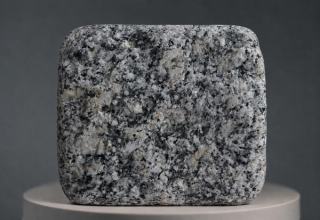
Natural granite already contains mineral grains, subtle colour variations, and individual differences from stone to stone.
When it is carefully aged, the edges become softer and the relationship between individual cobblestones becomes less mechanically precise.
These subtle irregularities can create an effective contrast with the accuracy of modern architecture.
The architecture remains clear.
The paving remains natural.
Together, they create a balanced composition.
This is why the value of aged granite cobblestones in contemporary projects is not to make modern architecture appear traditional. It is to introduce controlled natural variation into an otherwise highly rational architectural environment.
A Stronger Aged Effect Does Not Necessarily Mean a Better Result
One of the most common misunderstandings about aged granite cobblestones is that the more weathered they look, the more authentic or premium they become.
For modern architecture, the opposite can often be true.
If the edges are excessively worn, the surface texture is too pronounced, or the overall colour variation becomes too complex, the paving itself can turn into a dominant visual feature.
When a building already incorporates large glass façades, natural stone walls, dark metal structures, or other visually strong materials, heavily aged paving can begin to compete with the architecture.
High-end contemporary landscapes rarely depend on one material attracting all the attention. Their quality usually comes from the relationship between different materials.
For this reason, aged granite cobblestones suited to modern architecture often retain natural edge variation and a subtle sense of time without making every individual stone appear heavily weathered.
From a distance, the paving should feel calm and coherent.
Only when viewed more closely should the variations in edges, textures, and natural mineral structures become more apparent.
This principle of visual simplicity from a distance and material detail at close range works particularly well in contemporary landscape design.
Colour Should Support the Architecture Before It Highlights the Stone
When combining aged granite cobblestones with modern architecture, colour is often even more important than the degree of ageing.
Consider a contemporary residence dominated by light-grey walls, large glass surfaces, and black metal window frames.
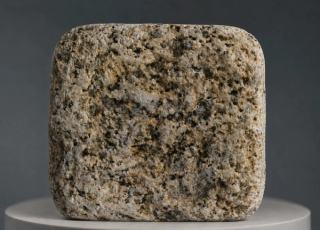
If the surrounding paving suddenly introduces large amounts of yellow-brown, reddish-brown, or highly contrasting mixed-colour cobblestones, the ground surface can become visually disconnected from the architecture.
This does not necessarily mean that the stone itself is unsuitable.
The problem is simply that the material does not establish a visual relationship with the building.
For modern architecture, dark grey, blue-grey, black-grey, muted green-grey, and other restrained colour combinations can often provide a more stable foundation.
Warm-toned granite can also work effectively, but the overall colour should usually remain controlled rather than allowing several strong colours to compete for attention.
This is particularly important in luxury residential and boutique hospitality projects.
The paving can subtly relate to the façade, roof, window frames, landscape walls, or other natural stone elements used throughout the project.
This relationship does not require an exact colour match.
In sophisticated landscape design, different materials often share subtle visual connections while maintaining their own character.
Simpler Paving Patterns Allow Aged Stone to Look More Refined
Aged granite cobblestones are often associated with European historic streets, where fan patterns, curved layouts, decorative arrangements, and irregular paving are common.
These patterns can be highly appropriate in historic districts and around traditional architecture.
Transferring them directly into a contemporary project, however, can quickly push the landscape toward an overly traditional appearance.
For modern architecture, simpler paving layouts are usually more effective.
Straight directional layouts, controlled staggered patterns, consistent paving bands, or the selective use of cobblestones within larger paved surfaces can all work well.
The more restrained the paving geometry, the more clearly the natural edges, mineral textures, and subtle colour variations of the granite can be appreciated.
There is an important design principle behind this:
When the material already contains natural variation, the layout does not need to introduce excessive additional complexity.
Much of the refinement found in contemporary landscape design comes from knowing what not to add.
Aged Cobblestones Do Not Need to Cover the Entire Surface
In contemporary residential projects, aged granite cobblestones do not necessarily need to become the dominant paving material across the whole site.
In many cases, they work particularly well as a transition material.
For example, large-format granite paving slabs can define the main pedestrian areas around a modern residence, while aged cobblestones are introduced along edges, driveway transitions, planting zones, or between the building and garden.
In this composition, the large-format paving maintains the scale and order associated with contemporary architecture, while the cobblestones introduce natural variation and texture.
The contrast in scale between the two materials also adds depth to the overall paving design.
A similar approach can be used for private driveways.
Granite cobblestones with appropriate thickness and installation conditions can define vehicle areas, while larger stone formats near the entrance can re-establish a cleaner pedestrian scale.
Compared with using exactly the same paving material from the driveway all the way to the front door, this transition often creates a more considered relationship between architecture and landscape.
Combining Aged Granite with Planting Helps Reduce an Overly Traditional Appearance
Whether aged stone feels too traditional is not determined by the paving material alone.
The surrounding landscape has an equally important influence.
If aged cobblestones are combined with traditional lanterns, ornamental ironwork, classical planters, and numerous decorative features, the overall space can develop a strongly historical character even when the ageing treatment of the stone itself is relatively subtle.
By contrast, combining aged granite cobblestones with restrained planting, contemporary landscape walls, large lawn areas, or geometric planting beds can significantly reduce this effect.
The stone then reads primarily as a natural and durable landscape material rather than as a decorative reference to the past.
Planting is particularly effective in contemporary residential courtyards because it creates a natural transition between stone paving and architectural surfaces.
As vegetation matures and the paving gradually develops genuine signs of use, the entire landscape becomes increasingly integrated.
This natural ageing process is often more convincing and visually enduring than trying to create an exaggerated aged appearance from the beginning.
The Overall Paved Surface Matters More Than a Single Stone
When designers and buyers select aged granite cobblestones, they naturally examine individual samples for edge wear, surface texture, colour, and tactile quality.
All of these characteristics matter.
However, a completed landscape is not experienced as one individual cobblestone.
It may contain hundreds or even thousands of square metres of paving.
A colour variation that looks attractive on a single sample can become visually chaotic when repeated across a large area.
Likewise, strong tonal contrasts that appear interesting in several individual stones may form unwanted colour patches once installed across an entire driveway or plaza.
For this reason, contemporary architectural projects require careful consideration of the overall batch appearance.
Colour distribution, ageing consistency, natural edge variation, and coordination between different production batches all become important.
High-quality aged paving does not mean making every cobblestone identical.
Natural granite should retain reasonable variation.
The goal is to keep that variation within a range that supports the overall design intention.
Aged Granite Cobblestones Are Not Exclusively for Traditional Architecture
Ageing is ultimately a method of modifying the surface character of natural stone.
It does not determine the architectural style of a project.
The same type of granite cobblestone can be used around a traditional estate, within a historic streetscape, or alongside a minimalist residence, boutique hotel, or contemporary commercial landscape.
What determines the final character is the combination of colour, dimensions, paving pattern, proportion, and the relationship between the stone, architecture, and surrounding materials.
For contemporary architecture, the ideal result is usually not for someone to immediately think:
“This project uses aged stone.”
A better reaction is:
“This paving feels completely natural here, as though it has always belonged to the architecture.”
When this balance is achieved, ageing is no longer a deliberately visible stylistic effect.
It becomes part of the relationship between architecture and landscape.
Conclusion
There is no inherent conflict between modern architecture and aged granite cobblestones.
What should be avoided is the excessive layering of historical character within the same space.
Controlling the degree of ageing, selecting colour tones that relate to the architecture, simplifying paving patterns, and carefully managing the proportion of cobblestones within the overall landscape can preserve the sense of time associated with natural stone without making the project feel overly traditional.
A successful contemporary landscape does not require every material to appear new, perfectly straight, and completely uniform.
Controlled natural variation can make modern architecture feel more grounded while allowing the landscape to mature gracefully over time.
For aged granite cobblestones, the goal should therefore not be to make the stone look as old as possible.
The real objective is to introduce just enough depth, warmth, and sense of time to enrich the landscape—without allowing the paving to compete with the architecture itself.