
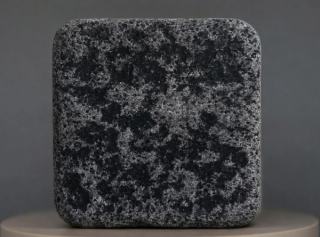
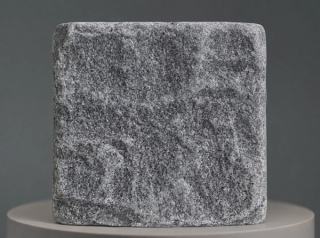
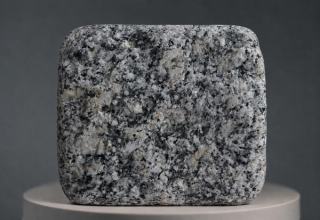
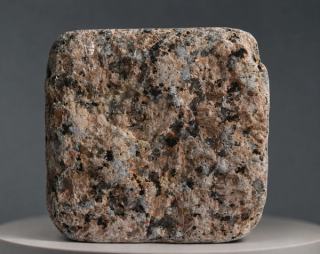
In manor courtyards, historic building renovations, boutique hotels, traditional commercial streets, and high-end residential landscapes, antique-finish granite cobblestones are often used to create paving with a sense of age and natural variation. However, what truly determines whether a large paved area looks natural is not simply the degree of antiquing on the stone surface.
Even when the same antique-finish granite cobblestone is used, a layout based entirely on uniform sizes, identical directions, and highly regular patterns can still create a noticeably modern grid effect. In contrast, combining different sizes in a controlled way can reduce visual repetition and create richer scale variations and a paving rhythm closer to traditional natural stone surfaces.
For this reason, mixed-size paving does not simply mean placing several sizes together at random. Designers, landscape contractors, and buyers need to determine which sizes should be selected, what proportion each size should represent, how natural variation can be created without making the paving look disorderly, and how the design proportions should eventually be converted into actual production and purchasing quantities.
The key to understanding mixed-size paving is not complete randomness, but creating natural variation within a controlled system.
Why Are Antique-Finish Granite Cobblestones Suitable for Mixed-Size Paving?
After additional finishing, antique-finish granite cobblestones usually develop edges, surface textures, and overall profiles that look different from ordinary machine-cut stone. The purpose of this material is not to emphasize absolute industrial uniformity, but to create the natural character associated with stone surfaces that appear to have aged over time.
If a project intended to express traditional architectural character or a historic atmosphere uses only a single size such as 100 × 100 mm, continuous paving can easily produce a repetitive square-grid rhythm. Although the stone itself may have an antique appearance, the overall layout can still look relatively regular.
If 100 × 150 mm and 100 × 200 mm units are introduced alongside the same stone and finish, the scale relationship across the paving surface begins to change. Instead of repeatedly seeing the same dimensions, the eye moves naturally between different lengths.
This variation is not intended to create disorder. Its purpose is to reduce mechanical repetition and allow the natural texture, overall color variation, and antique character of the granite to integrate more naturally into the surrounding space.
More Sizes Do Not Necessarily Create a Better Result
One of the most common misunderstandings about mixed-size paving is that using more sizes will automatically make the finished surface look more natural.
In practice, if too many sizes are used within one area without a clear relationship between them, it becomes difficult for installers to maintain a consistent paving logic. One size may become concentrated in one area while another appears excessively elsewhere. Installers may even begin changing the pattern simply to use up remaining pieces.
The result is not natural variation, but visual disorder.
For most landscape projects, a better approach is to establish a size system that can be repeated during installation without creating an overly mechanical appearance. For example, different lengths can be developed around a common width, such as 100 × 100 mm, 100 × 150 mm, and 100 × 200 mm.
These three sizes maintain a basic dimensional relationship while creating rhythm through variations in length. This makes design layout, production calculation, and site installation easier while reducing the repetitive effect of a single-size paving pattern.
The objective of mixed-size design is therefore not to maximize the number of dimensions, but to establish a clear, practical, and coordinated relationship between them.
Proportion Is What Really Determines the Paving Effect
Selecting several sizes is only the first step. Another critical factor is determining how much of each size should be used.
For example, a paving scheme may use 100 × 100 mm, 100 × 150 mm, and 100 × 200 mm cobblestones. If the 100 × 100 mm size represents 70% of the total, while the other two sizes are used only occasionally, the finished surface will still be visually dominated by smaller square stones, with only limited dimensional variation.
If the proportions of the three sizes are more balanced, the mixed-size character will become much more visible. If longer pieces represent a higher proportion, the paving may also develop a stronger directional character.
For this reason, the design and purchasing documents should not simply state that multiple sizes are required. The quantity or paved-area proportion of each size should also be defined.
For example:
100 × 100 × 50 mm: 40%
100 × 150 × 50 mm: 35%
100 × 200 × 50 mm: 25%
These percentages are only an example of how proportion control works. They are not a standard formula for every project. Actual proportions should be adjusted according to pavement width, total area, architectural style, functional requirements, and the desired visual effect.
The important point is that these proportions should be determined before production and installation rather than being left entirely to random decisions on site.
Natural Paving Does Not Mean Completely Random Paving
Traditional-looking stone paving may appear irregular at first glance, but well-executed projects usually still follow an underlying order.
For example, identical larger pieces should not appear continuously over long distances. One smaller size should not become concentrated in a single area. Long continuous straight lines should be interrupted where appropriate. Different lengths should alternate naturally, while building edges and corners should maintain relatively stable finishing relationships.
Mixed-size paving is therefore better understood as controlled random variation.
During the design stage, the basic size system and approximate proportions should first be established. During installation, a certain degree of natural variation can then be allowed while still following several basic layout principles.
This approach reduces the repetitive appearance associated with highly standardized paving while preventing genuine disorder.
It becomes particularly important on projects covering hundreds or even thousands of square metres. Without clear rules, different installation teams may interpret “random paving” differently, resulting in noticeable visual differences between separate construction areas.
Different Spaces Can Use Different Size Rhythms
Mixed-size paving can also help designers establish a hierarchy between different spaces.
A project does not necessarily need to use exactly the same size proportions from the entrance to the courtyard or from the main route to secondary paths. At the entrance of a manor, hotel, or high-end residential development, for example, the proportion of larger cobblestones can be increased to create a more stable character in the primary circulation area.
Within an inner courtyard, greater variation between small and medium sizes can create a more detailed pedestrian-scale surface.
Around building edges, planting beds, narrow passages, and other areas with limited dimensions, the size combination can be adjusted according to site conditions to reduce unnecessary small cut pieces.
In this way, mixed-size design becomes more than a decorative technique. It can participate in the organization of the overall space. Even when the granite color and surface finish remain unchanged, subtle changes in size proportions and paving rhythm can distinguish different areas.
Why Should Boundary Areas Be Considered Separately?
The interior of a large paved area can accommodate relatively rich size variation, but areas close to building walls, steps, kerbstones, drainage channels, planting beds, and other fixed boundaries usually require a different approach.
The reason is straightforward: the paving must eventually meet a fixed geometric edge.
If completely random paving continues all the way to the final row, a large number of narrow cut pieces may be required. This can reduce visual integrity while increasing cutting and installation difficulty on site.
Mixed-size paving should therefore consider both the internal paving rhythm and the treatment of boundaries. Designers can determine which sizes are more suitable near edges or gradually adjust the size combination across several preceding rows rather than leaving every dimensional conflict to the final row.
The objective here is not simply to control joint widths, but to use the available sizes intelligently so that the overall paving system reaches the boundary in a natural and practical way.
Mixed-Size Design Must Be Considered During Purchasing and Production
Once a mixed-size scheme has been determined, it cannot remain only in a rendering or design concept. It must be converted into a purchasing schedule that the manufacturer can actually produce.
For example, if a project requires 800 square metres of antique-finish granite cobblestones but the purchasing document specifies only the total area without defining the proportion of each size, the production team cannot accurately determine how much of each dimension should be manufactured.
Complete purchasing information should therefore specify the granite type, surface finish, length, width and thickness of each size, quantity or area proportion for each specification, total required quantity, and appropriate allowances for wastage and future replacement.
For large projects, packaging and identification of different sizes can also be considered according to the construction sequence. This allows installers to identify different specifications quickly and take material according to the planned proportions.
Otherwise, even a well-designed size ratio may eventually change if one particular size is used up too early during construction.
Paving Mock-Ups Should Verify the Overall Rhythm
Before large-scale installation, mixed-size antique-finish granite cobblestones are particularly suitable for testing through a paving mock-up of sufficient area.
The purpose of the mock-up is not only to confirm the granite color and surface finish. More importantly, it should verify the relationship between different sizes: whether the proportions of larger, medium, and smaller pieces are balanced, whether one particular size becomes too dominant, whether the layout appears too regular, and whether the intended paving rhythm can be perceived from a normal viewing and walking distance.
Simply placing several different-sized samples next to each other is not enough to evaluate the final effect.
Only when the materials are installed according to the planned proportions can designers and buyers judge whether the original size distribution is appropriate and make adjustments before full production or large-scale installation.
For larger projects, the mock-up can also establish which variations should be retained as part of the intended natural character and which arrangements should be avoided during construction. This helps maintain a more consistent design language across different paving zones.
The Core of Mixed-Size Paving Is Controlled Natural Variation
Mixed-size paving with antique-finish granite cobblestones is not simply a matter of adding more dimensions. It is a control system extending from design to purchasing, production, and installation.
A suitable dimensional system should first be established, followed by clear proportions between different sizes. Controlled variation can then reduce mechanical repetition, while the size rhythm can be adjusted according to entrances, main routes, courtyards, and boundary conditions. Finally, the design proportions need to be translated into clear purchasing quantities, production plans, packaging identification, and site installation guidelines.
Modern landscape projects do not need to mechanically reproduce streets built hundreds of years ago. What is worth learning from traditional natural stone paving is its rich but controlled variation in scale.
Successful mixed-size antique paving is therefore neither completely uniform nor completely random. Instead, different sizes alternate naturally within a dimensional system that can be manufactured, installed, and controlled.
The finished space should first be perceived as complete, coordinated, and naturally aged rather than as a deliberately constructed combination of different stone sizes.
That is the essential design logic behind mixed-size paving with antique-finish granite cobblestones.