
In high-end residential developments, boutique hotels, commercial buildings, private estates, and high-standard public landscape projects, natural granite is rarely used in just one location. Building entrances, primary pedestrian areas, vehicular and drop-off zones, courtyards, steps, garden paths, and landscape edges may all require different forms of granite.
For designers, the real challenge is not simply deciding which granite is “best,” but determining how different granite materials should be assigned according to spatial importance, functional requirements, architectural relationships, and the way people experience the space.
A high-standard material strategy does not mean using the most expensive or visually distinctive stone everywhere. A mature material hierarchy establishes clear priorities: some areas create the first impression, some provide a calm and continuous background, some must withstand vehicle loads, while others occupy only a small area but determine the overall level of detailing and refinement.
The key to natural granite selection should therefore shift from choosing individual products to assigning appropriate material roles.
Why Do High-Standard Landscapes Need a Material Hierarchy?
If the main entrance, primary walkways, vehicular areas, courtyards, and landscape edges all use materials with the same visual intensity, the project can easily lose its sense of hierarchy. This becomes particularly noticeable when several colours, surface finishes, and sizes are introduced without a clear relationship between them. Each stone may look attractive individually, yet the completed landscape can still feel visually fragmented.
A mature landscape design usually begins by identifying the importance and function of each space before deciding what role the stone should play.
The main entrance may require stronger material expression. Primary paving needs stability and visual continuity. Vehicular areas must prioritise engineering performance. Courtyards and gardens emphasise close-range material experience. Granite kerbs and edging elements organise transitions and complete the overall paving system.
This hierarchy is not a hierarchy of price. It is a hierarchy of spatial roles.
First Level: Main Entrances and Building Forecourts — Creating the First Impression
The main entrance is often one of the most carefully controlled material zones in a high-standard project. From the entrance gate and drop-off area to the forecourt immediately in front of the building, this is where people first experience the relationship between architecture and landscape.
Natural granite selection here needs to consider the building façade, overall colour palette, surface texture, paving scale, and close-range detailing.
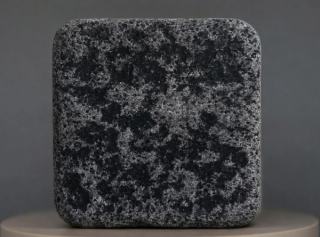
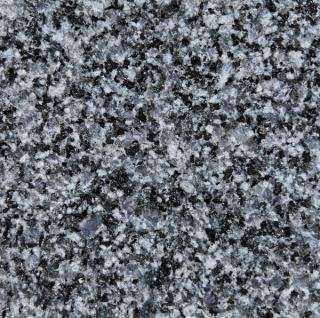
Contemporary architecture can work particularly well with restrained grey, dark grey, charcoal, or blue-grey granite. Large-format custom granite slabs can establish a strong architectural scale, while premium granite cobblestones or setts with distinctive natural crystals and mineral characteristics can be introduced selectively to add material identity.
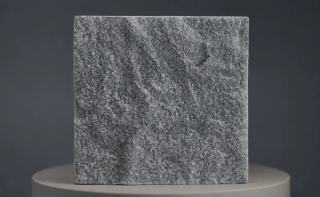
For estates, traditional architecture, or projects seeking a more mature landscape character, antique-finish granite cobblestones can introduce softer edges, natural tonal variation, and a sense of age that helps new paving sit more naturally within its surroundings.
However, a higher material hierarchy at the entrance does not mean the paving should dominate visually. The best entrance materials strengthen the architectural composition rather than compete with it.
Second Level: Primary Paving Areas — Establishing Spatial Order
Primary pedestrian routes, building perimeter paving, central courtyards, and large public open spaces often account for the largest paved areas within a project.
Their role is not to create constant visual focal points. Instead, they should provide a stable, continuous, and durable background for the architecture and landscape.
For this reason, large-area natural granite selection should focus on overall colour consistency, dimensional systems, finish consistency, and coordination between different production batches.
Large-format granite slabs can create calm and visually continuous surfaces, particularly in building forecourts and principal pedestrian areas. The stronger the relationship with the architecture, the more important it becomes to consider slab dimensions, joint direction, and the overall paving grid.
The question here is not how distinctive a single slab looks. The real question is whether hundreds or thousands of square metres of paving can maintain a coherent visual order.
Third Level: Vehicular and Drop-Off Areas — Combining Performance with Design Language
Hotel drop-off zones, private driveways, residential access roads, commercial vehicle routes, and internal vehicular areas have very different requirements from ordinary pedestrian paving.
These areas are repeatedly exposed to vehicle loads, tyre abrasion, turning forces, and intensive use. Material selection therefore needs to prioritise thickness, strength, slip resistance, wear resistance, and the overall paving structure.
Granite cobblestones are particularly suitable for many of these environments. Their relatively small units can adapt to straight routes, curves, turning areas, and complex boundaries, while natural granite provides the durability required for long-term outdoor use.
However, vehicular paving in a high-standard project should still remain part of the overall material language.
If the building entrance uses grey large-format granite slabs, for example, the adjacent driveway can use granite cobblestones in a similar or slightly darker tone. The change in unit size and surface texture distinguishes the vehicular zone without introducing an unrelated colour.
The result is a clear functional hierarchy combined with visual continuity.
Fourth Level: Courtyards and Gardens — Bringing Natural Stone Closer to Human Experience
Courtyards, garden paths, terraces, and leisure spaces are usually experienced at a much closer distance than large forecourts.
People spend more time in these areas and are more likely to notice the crystals, mineral grains, edges, surface relief, and joints of the stone. These spaces therefore provide an opportunity to express the natural character of granite more clearly.
Premium granite cobblestones can introduce richer close-range texture through natural mineral variation and refined surface finishes. Antique-finish granite cobblestones can create softer edges and more subtle tonal variation, helping courtyards and gardens develop a mature and established character.
This illustrates an important principle of material hierarchy: premium materials do not necessarily need to cover the largest area. They should be used where their qualities can be most clearly perceived.
Fifth Level: Granite Kerbs and Landscape Edges — Small in Area, Critical to the Finished Result
Granite kerbs are often regarded primarily as engineering components, but in high-standard landscapes they also perform an important spatial design function.
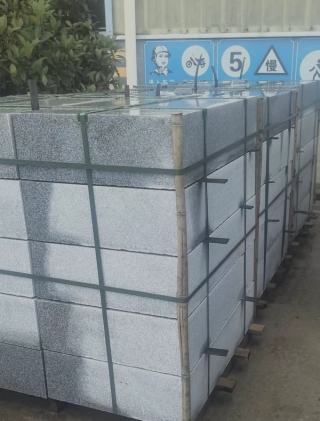
Transitions between vehicular and pedestrian areas, paving and lawns, roads and planting beds, or different paving materials all require carefully controlled edges. High-quality granite kerbs can stabilise paving, manage level changes, and create continuous linear order.
Edge materials usually do not need to become the visual focus. If the primary paving already has a strong material character, the kerb should often remain restrained. Where roads, curves, or landscape geometry require clearer definition, slightly darker tones, consistent dimensions, or precisely manufactured curved kerbs can strengthen the boundary.
Good kerb design does not necessarily make people notice the kerb itself. Instead, it makes the entire space feel complete, controlled, and resolved.
A Material Hierarchy Does Not Mean Using More Types of Stone
One of the most common misunderstandings is that creating hierarchy requires introducing more colours and more stone varieties.
In reality, high-standard projects often benefit from a controlled material palette. Variation can be created through product format, dimensions, and surface finishes rather than constantly changing stone types.
For example, one grey granite family can form the basis of an entire project. Large-format slabs can be used in the building forecourt, cobblestones in vehicular areas, granite kerbs along landscape edges, and premium or antique-finish cobblestones selectively introduced into courtyards.
The project then contains several material layers while maintaining a coherent visual identity.
Use Scale, Surface Finish, and Position to Build Hierarchy
Natural granite hierarchy is not created by colour alone.
Large-format slabs create a sense of “plane” and are well suited to architectural scale and spatial order. Cobblestones create a finer “texture” that works effectively in driveways, courtyards, and transition areas. Granite kerbs create “lines” that define edges and complete paving boundaries.
Surface finish can also reinforce this hierarchy. The same granite can be treated with different outdoor finishes according to location and function, allowing tactile and visual variation while maintaining a consistent overall colour palette.
High-standard design therefore depends on coordinating colour, scale, texture, and spatial position rather than relying on one element to create a premium appearance.
Mock-Ups Should Test the Material System, Not Just Individual Stones
Once the material hierarchy has been established, samples and paving mock-ups should be used to verify how the materials work together.
A granite slab, cobblestone, and kerb may each look appropriate when viewed separately. Once combined, however, the slab scale may feel too large, the cobblestone pattern too visually dense, the edge too dominant, or the overall colours insufficiently coordinated.
For this reason, mock-ups for high-standard projects should evaluate the relationship between materials, including overall colour, dimensional proportion, finish variation, actual joint width, edge definition, and the appearance from normal viewing distances.
The objective is no longer simply to decide whether an individual stone looks attractive. It is to determine whether the complete natural granite palette supports the architecture and landscape as one coherent system.
From Selecting Stone to Assigning Material Roles
A mature material strategy for a high-standard landscape begins with understanding the space before selecting the stone.
The main entrance establishes the first impression. Primary paving creates overall order. Vehicular areas provide long-term stability and durability. Courtyards and gardens offer a closer material experience. Granite kerbs and landscape edges complete the spatial structure.
Premium granite cobblestones, antique-finish granite cobblestones, custom granite slabs, and high-quality granite kerbs should not be treated as four unrelated product categories. For designers, they can become different components within one coherent natural granite material language.
When the design process shifts from asking “Which stone is the best?” to “Which material is right for this particular location?”, natural granite becomes part of the design system rather than simply a paving product.
Ultimately, the quality of a high-standard landscape is not determined by how many expensive stones are used. It depends on whether each material is placed in the right location and whether its colour, scale, texture, function, and relationship with the architecture work together as a clear and enduring whole.