
In urban roads, commercial developments, hotel landscapes, high-end residential projects and public spaces, granite kerbstones do more than separate paving areas from roads.
They also create a continuous visual boundary within the landscape.
When a single kerbstone is inspected individually, a few millimetres of dimensional variation, a slight deviation along an edge or a small difference in surface finish may not appear significant. But when dozens or hundreds of kerbstones are installed continuously, these small variations can accumulate and directly affect the alignment, joint consistency, elevation and overall appearance of the finished kerb line.
For this reason, quality control for high-quality granite kerbstones should not focus only on whether each individual piece meets the specified dimensions.
The more important question is whether a large quantity of kerbstones can maintain consistent straightness, dimensional relationships and a coordinated surface appearance after installation.
Why Is Straightness Particularly Important for Granite Kerbstones?
Paving slabs primarily create a surface, while kerbstones primarily create a line.
Whether they are used along road edges, driveways, planting areas or plazas, the eye naturally follows the kerb line into the distance. Long, continuous installations therefore make even small deviations much easier to notice.
For example, a slight deviation along the edge of a one-metre granite kerbstone may be difficult to identify when the piece is viewed individually. However, if dozens of pieces with inconsistent long edges are installed in sequence, a boundary that should appear straight may begin to look uneven.
From close range, each individual stone may appear acceptable.
But when viewed from ten or twenty metres away, the overall straightness of the kerb line becomes much easier to judge.
Straightness control is therefore not simply about making one kerbstone more precise. Its real purpose is to ensure a stable and continuous line after installation.
Straightness Begins with Stable Processing References
Granite is a natural material, but under normal conditions, significant straightness problems in kerbstones are more closely related to processing control.
For longer kerbstones in particular, clear and stable reference faces and reference edges should be established during cutting and subsequent processing.
If the processing reference changes between different stages, or if length, width and height are checked independently without considering the relationship between the long edges, a particular problem can occur:
Individual dimensions may all appear to fall within the accepted tolerance, while the kerbstone itself still shows slight bowing, twisting or irregularity along the edge.
Straightness should therefore not be evaluated completely independently from dimensional accuracy.
For longer granite kerbstones, the relationship between the long edges, top surface and side faces should also remain stable.
This is particularly important at modern building entrances, commercial plazas and long road sections, where the landscape design often relies on clean, continuous lines. Such designs naturally make straightness more visually important.
Dimensional Compliance Does Not Always Mean Batch Consistency
Granite kerbstones generally require control of length, width and height. Some custom products may also include chamfers, sloping faces, rounded edges or other special dimensions.
These dimensions must first comply with the project drawings and the agreed production requirements.
However, large projects introduce another important consideration: dimensional consistency across the entire batch.
Suppose every individual kerbstone falls within the permitted dimensional tolerance, but one group tends toward the upper end of the tolerance while another tends toward the lower end. Visible differences can still occur when these pieces are installed together.
Variations in height can increase the amount of on-site levelling required. Width variations may affect the relationship between the kerbstone, adjacent paving, roadway or foundation. Excessive variation in length can also affect the regularity of joints.
Therefore, dimensional control in large-volume production should not only ask:
“Is every individual piece within tolerance?”
It should also ask:
“Is dimensional variation across the entire batch sufficiently stable?”
The first determines whether an individual product is acceptable. The second directly affects installation efficiency and the quality of the finished project.
Why Is Consistent Height Especially Important?
After granite kerbstones are installed, the continuous top line is usually one of their most visible characteristics.
If neighbouring pieces have noticeable differences in height, installers may compensate by adjusting the bedding or foundation, but this increases installation difficulty.
Over several hundred metres of kerbing, repeated dimensional adjustments can significantly increase the amount of work required on site.
At hotel entrances, high-end residences, commercial plazas and contemporary landscape projects, the top line of the kerbstone is often part of the overall spatial order.
Height should therefore not be considered simply as a production measurement.
It directly influences whether the completed kerb line appears smooth, continuous and professionally installed.
Width and Length Also Affect Installation
Kerbstones rarely function independently.
They may connect with granite cobblestones, paving slabs, asphalt roads, concrete foundations, drainage structures or other landscape materials.
If width varies significantly, the difference may not always be immediately visible from the front, but it can alter the rear alignment or the relationship with adjacent paving, requiring additional adjustment during installation.
Length directly affects joint consistency.
For projects using kerbstones of uniform length, stable dimensions help create regular joint spacing. If lengths vary too widely, installers must continually compensate by adjusting the joints.
High-quality dimensional control therefore does not mean pursuing unnecessary extreme precision.
It means maintaining length, width and height within a reasonable and stable range appropriate to the actual project requirements.
Surface Consistency Does Not Mean Every Natural Stone Must Look Identical
Granite is a natural material.
Reasonable variations in mineral particles, crystals, colour and texture are inherent characteristics of natural granite.
Surface consistency in high-quality kerbstones therefore does not mean making every piece look exactly like an industrially manufactured product.
What needs to be controlled are two different types of variation:
Natural variation in the stone itself, and variation introduced during processing.
Reasonable natural colour variation can remain, but unstable processing should not cause significant differences in surface appearance between kerbstones made from similar material.
For example, with flamed, bush-hammered or other textured finishes, differences in processing intensity can cause surfaces to appear lighter or darker even when the raw granite is within a similar colour range.
The purpose of quality control is therefore not to remove the natural character of granite, but to minimise unnecessary variation caused by processing.
Large-Volume Production Requires Batch Consistency
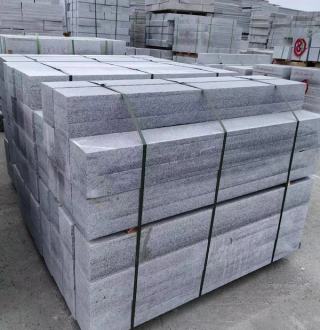
A large kerbstone project may require hundreds or even thousands of pieces, and they are unlikely to be produced at exactly the same time.
Different granite blocks, different production stages and changes in equipment condition can all influence the finished product.
This is why a good sample alone cannot guarantee consistent quality throughout a large order.
For major projects, it is more important to determine whether the same standards can be maintained throughout the production process.
Are dimensions stable from the beginning to the end of production? Does the surface finish remain consistent? Are the colour ranges of different raw material blocks properly coordinated?
If these issues are only inspected after production has been completed, there may be very little opportunity for adjustment.
Batch management for high-quality granite kerbstones should therefore continue throughout production rather than relying only on final random inspection.
Natural Colour Variation Should Be Distributed Properly
Natural colour variation is normal in granite.
In large projects, the real issue is often not whether colour variation exists, but how that variation is distributed.
If noticeably darker kerbstones are concentrated in one section while lighter pieces are installed in another, long continuous runs may develop visible colour zones.
For projects with higher visual requirements, the overall colour range can be controlled during raw material selection and production, while noticeably different pieces can be coordinated appropriately.
The objective is not to make natural granite look artificially uniform.
Instead, reasonable natural variation should be distributed across the project so that the finished kerb line appears balanced and visually coordinated.
Custom Kerbstones Should Not Be Evaluated Only as Individual Pieces
Not every granite kerbstone is a simple rectangular unit.
Some projects require sloping kerbstones, curved kerbstones, corner pieces, transition kerbs or other custom shapes.
These products need to be evaluated according to their relationship with the overall installation.
For example, even if every individual curved kerbstone appears well manufactured, this does not necessarily mean that the assembled pieces will form the correct curve.
What matters is whether multiple units can create the required radius and a smooth continuous line after installation.
The same applies to transition kerbstones. Their quality depends not only on the individual shape, but also on how smoothly they connect with the units before and after them.
Quality control for custom granite kerbstones therefore needs to consider where each piece belongs within the project and how it connects with adjacent units.
Packaging and Numbering Are Also Part of Quality Control
Quality control does not end when processing is completed.
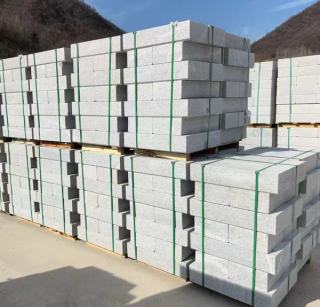
Granite kerbstones are heavy products. Without adequate protection during handling and transportation, edges can be chipped, surfaces can rub against one another and individual pieces can be damaged.
This is particularly important for kerbstones with chamfers, special edge details or carefully processed surfaces.
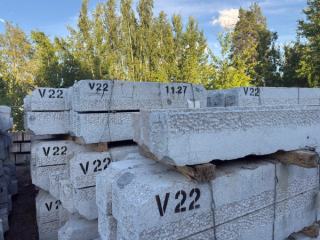
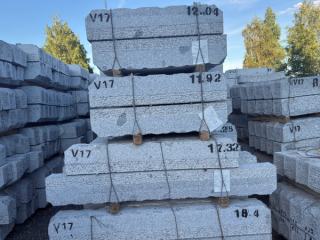
Large projects may also include several dimensions and different installation zones. Without clear numbering and organised packaging, materials may need to be sorted again after arriving on site.
This reduces installation efficiency and can disrupt previously planned batch or colour distribution.
Processing, inspection, numbering, packaging and transportation should therefore be treated as one continuous quality-control process.
A Single Sample Is Not Enough to Evaluate High-Quality Granite Kerbstones
Samples are useful for helping landscape designers, contractors and buyers confirm granite colour, surface finish and basic processing quality.
For a large project, however, the more important question is whether the quality represented by that sample can be consistently reproduced across hundreds or thousands of kerbstones.
When evaluating a granite kerbstone supplier, it is therefore important to look beyond the sample and consider how raw materials, processing references, straightness, dimensions, surface finishing and production batches are controlled.
Producing one attractive sample is relatively straightforward.
Maintaining stable quality across a large quantity of products and achieving a coordinated result after installation is much more demanding.
High Quality Is Ultimately Visible in the Completed Kerb Line
The quality of granite kerbstones can ultimately be evaluated through several practical questions.
After continuous installation, is the top line smooth? Is the road or landscape boundary straight and stable? Are neighbouring kerbstones consistent in height? Are the joints regular? Is the surface finish coordinated? Are natural colour variations distributed appropriately?
Together, these factors determine the quality of the completed project.
Straightness, dimensional accuracy and surface consistency should therefore not be treated as three separate quality indicators.
They all serve the same objective:
To ensure that a large quantity of granite kerbstones, once installed continuously, creates a smooth, stable and visually coordinated landscape boundary that meets the original design requirements.
The processing accuracy of an individual piece determines whether a granite kerbstone is acceptable.
But it is the consistency of the entire production batch—and its performance after continuous installation—that truly defines the engineering value of high-quality granite kerbstones.