
A granite paving scheme can look very different five years after completion from the way it appeared on opening day.
When a landscape is first installed, young trees have relatively small canopies, shrubs have not yet reached their mature spread, and paving often occupies a large proportion of the visual field. As planting develops, however, tree canopies expand, shade moves across paths and courtyards, planting begins to soften hard edges, and fallen leaves, irrigation and seasonal growth gradually change the way paved surfaces are experienced.
The stone itself may remain almost unchanged, while the landscape around it continues to evolve.
For landscape architects, this is one of the most important reasons why natural granite paving should not be designed only for the appearance of a newly completed project. The relationship between hard landscape and soft landscape needs to remain convincing as planting matures.
The question is therefore not simply how to detail granite around a tree pit. It is how the scale, colour, texture and edge conditions of the paving should respond to a living landscape.
1. Decide whether paving should structure the space or sit quietly behind the planting
Natural stone plays different visual roles in different parts of a project.
At a principal entrance, forecourt or civic plaza, granite paving may be one of the main elements establishing spatial order. Large-format granite slabs, controlled joint lines and a clear paving grid can reinforce building axes, façade proportions and arrival sequences.
The relationship often changes once the route moves into a planted courtyard, garden or tree-lined pedestrian space.
Here, the visual focus may shift towards tree canopies, planting composition, water, filtered light and places to sit. The paving remains important, but it does not always need the same visual authority as the main entrance.
One approach is to retain a consistent overall stone palette while gradually reducing the paving unit size.
Large granite slabs may dominate the architectural forecourt, while smaller slabs or granite setts are introduced around planted areas, secondary paths and more intimate courtyards.
The material family remains coherent, but the surface becomes finer in scale and less architectural in character.
This is not a reduction in material quality. It is a change in visual hierarchy.
2. A tree pit should be designed as part of the landscape composition
Tree pits are often treated as technical openings within an otherwise continuous paved area.
In well-resolved public realm and landscape schemes, they can do much more than that.
Within a formal entrance space or regular avenue, tree pits can align with the paving module, structural grid or principal building geometry. The trees then appear to belong to the overall spatial order rather than being inserted into the paving afterwards.
A more naturalistic courtyard may require a different approach.
If every tree is surrounded by a broad dark granite frame, planting can become visually isolated into a series of hard-edged islands.
Where planting is intended to feel softer and more continuous, the edge can be deliberately reduced.
A narrow granite edging, a tone close to the main paving, smaller stone units or granite setts can create a more restrained transition between paving and planting.
The important point is that there is no single correct tree-pit detail.
The stronger the architectural character of the space, the more clearly defined the stone edge may become. Where planting is intended to dominate, the edge may need to recede.
3. Irregular planting edges should not control the entire paving grid
Curved planting beds, circular tree pits and organically shaped planted areas often meet regular slab paving.
This creates an obvious geometric conflict.
If every large granite slab is cut individually to follow every curve, the principal paving field can quickly become fragmented by narrow pieces, triangular cuts and irregular joints.
A more controlled strategy is to keep the main paving grid stable and absorb the geometric complexity close to the planting edge.
For example, a forecourt may retain a regular large-format granite slab layout, while a smaller-format granite band or granite sett margin negotiates the transition to a curved planting bed.
The large slabs establish order.
The smaller stone units deal with the changing geometry.
This is also where custom-cut granite has the greatest value. Bespoke stone should not automatically mean that every paving unit becomes an irregular shape.
A limited number of carefully designed special pieces can protect the clarity of the main paving system while resolving the areas where standard modules no longer work.
4. Design for mature planting, not only the planting shown on the completion plan
Planting does not remain fixed.
Shrubs spread, herbaceous planting reaches the edge of paving, tree canopies expand and some initially prominent stone edges may gradually become partially concealed.
This raises a useful design question:
Will this granite edge still need to be visually dominant once the planting has matured?
At a ceremonial entrance, formal avenue or important architectural frontage, a clearly expressed granite edge may remain essential because it helps preserve long-term geometry.
In a garden or informal courtyard, however, a heavily detailed edge may become unnecessary once planting softens the boundary.
Designing for maturity does not mean predicting the exact shape of every plant several years in advance.
It means recognising that the balance between paving and planting will change.
A successful hard landscape should be able to accommodate that change rather than relying entirely on the crispness of the day-one photograph.
5. Tree shade changes the way granite colour is perceived
Natural granite does not appear identical under all light conditions.
In direct sunlight, mineral crystals, grain and subtle tonal variation can become more visible. Under a mature tree canopy, the same material may appear quieter, darker and more uniform.
This matters because areas that are fully exposed when a project is first completed may become heavily shaded several years later.
Dark grey, charcoal and black granite require particular consideration.
A stone that looks refined and richly textured in bright daylight can create a much heavier surface once it sits beneath dense planting and prolonged shade.
For tree-lined paths and planted courtyards, material approval should therefore go beyond examining a small sample indoors.
Where possible, the designer should consider how the stone reads in open daylight, in shade and across a larger laid area.
The objective is not to eliminate the natural character of granite, but to understand whether its overall tone remains appropriate as the landscape changes.
6. Planting brings leaves, soil, irrigation water and maintenance into the paving environment
The relationship between stone and planting is also practical.
Fallen leaves, pollen, soil, organic debris and irrigation water are continually introduced into planted landscapes. These materials often accumulate close to bed edges, tree pits and paving joints.
In shaded locations, surfaces may also dry more slowly.
For this reason, surface finish should not be selected purely for visual texture.
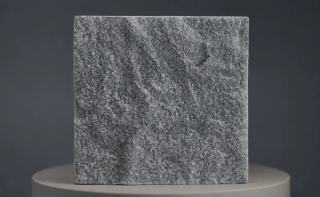
Split, heavily textured and other naturally rugged finishes can provide strong material character, but areas exposed to regular leaf fall and maintenance may behave differently from a more open architectural forecourt.
The designer therefore needs to balance several factors:
slip resistance, pedestrian comfort, desired texture, cleaning requirements and long-term maintenance.
A natural-looking surface is not automatically the best solution in every planted area.
Likewise, a more controlled granite finish does not have to appear overly formal if the colour, unit size and joint pattern are well coordinated with the planting.
7. Irrigation and paving should not be designed as separate systems
Planting requires water. Granite paving does not benefit from being unnecessarily kept wet.
Where irrigation overspray continually reaches stone paving and joints, a locally damp environment can develop, particularly under dense shade or where leaves and soil accumulate.
This does not mean paving should simply be kept away from planting.
It means irrigation coverage, drainage and paving should be coordinated rather than developed independently.
In planted courtyards, hotel gardens and residential landscapes, the designer should understand where water is likely to fall before finalising paving finish, joints and edge conditions.
The same principle applies to drainage.
Hard landscape and soft landscape are part of one outdoor system. Water movement across paving, planted areas and tree pits should therefore be considered together.
8. Granite kerbs and edge restraints do not always need to be visually dominant
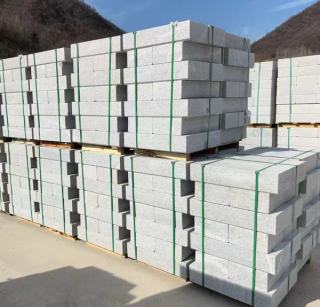
Granite kerbs and edge restraints perform important practical roles.
They can retain paving, manage level changes and define the boundary between paths, vehicle areas, lawns and planting beds.
They are also strong linear elements within the landscape.
At road edges, arrival spaces and formal avenues, that line can be intentionally visible. A continuous granite kerb can reinforce direction and give the landscape a clear structural framework.
Inside gardens and softer planted courtyards, the same treatment may feel too heavy.
Reducing the exposed face, selecting a colour close to the main paving or using smaller granite units at the transition can make the boundary less visually assertive.
A successful edge detail is not necessarily one that attracts attention.
Often the best detail is the one that quietly keeps paving and planting organised without becoming a design feature in its own right.
9. Granite setts can help bridge architectural paving and softer landscape areas
Granite setts are particularly useful where a project moves from a highly controlled architectural setting into a more planted environment.
Large-format granite slabs create a calm, low-joint-density surface that works well around principal entrances and major building frontages.
Granite setts offer a smaller module, greater flexibility around curved planting edges and a stronger relationship with the human scale.
They can therefore act as a transitional material rather than simply as a separate paving product.
In contemporary projects, this does not require a deliberately historic appearance.
A modern building may retain large-format granite slabs at the entrance while using carefully selected granite setts around internal courtyards, planted paths or secondary landscape spaces.
Antique or aged granite setts can be introduced more selectively where a softer, more established landscape character is required.
The aim should be to create a hierarchy between architectural precision and landscape texture, rather than to force the entire project into one stylistic language.
10. Seasonal change should be considered when choosing the overall stone palette
Planting colour changes throughout the year.
Spring foliage may be pale and fresh, summer planting becomes dense and green, autumn introduces warm leaves and fallen material, while winter often exposes more paving and structural branches.
The same granite therefore sits against several different visual backgrounds over the course of a year.
A stone selected to look perfect beside summer planting may behave differently once vegetation recedes in winter.
Likewise, a strongly coloured paving material that appears balanced against autumn foliage may dominate during other seasons.
For courtyards, estate landscapes, hospitality projects and public realm schemes with strong seasonal planting, the most durable material palettes are often those that remain visually stable throughout the year.
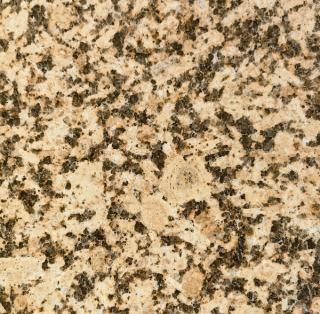
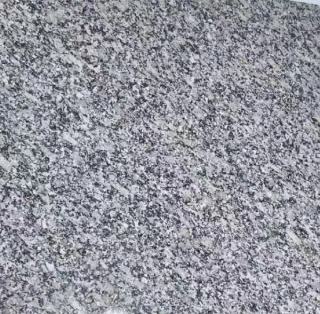
Natural grey, warm grey, darker neutral tones and granites with controlled mineral variation can work particularly well because they can support changing planting rather than compete with it.
The stone should have character, but it does not need to become the focal point in every season.
Conclusion: good hard landscape should still work when the planting matures
The relationship between natural granite paving and planting is not simply a matter of detailing stone around vegetation.
It is a question of how hard landscape should change its role as a project moves from architecture into landscape.
Large-format granite slabs can establish order close to buildings. Smaller paving units and granite setts can introduce a more intimate scale around courtyards and planted paths. Tree pits and planting beds can have either strong or restrained edges depending on the character of the space. Granite kerbs can reinforce formal geometry or become visually quieter where the landscape needs to feel softer.
Shade, irrigation, leaf fall and seasonal change further influence how the stone is seen, used and maintained.
For landscape architects, the most useful question is therefore not only:
How will this granite paving look when the project opens?
It is also:
How will it work once the trees have grown, the planting has matured and the landscape has started to develop its own character?
When natural granite continues to support the architecture, planting and long-term use of the site after that transition has taken place, the paving has become more than a surface finish. It has become part of a durable landscape framework.